

My ‘horror moments’ examine horror-inflected scenes and themes in unexpected places. They are published weekly on Thursdays and come out in series of ten articles focussing on a particular source e.g. ‘Wallace & Gromit,’ ‘Shakespeare,’ or ‘Kate Bush Songs’. Catch up with the recent series on Church Architecture mini-series here and browse the full back catalogue of horror moments here.
Hey kids! Want to watch a cartoon that was banned in Denmark for being ‘too macabre’?
Welcome one and welcome all to a brand new series: Horror Moments, Classic Disney Edition. If you’re a massive Disney fan let me enhance/spoil some of your favourite films by exploring all the scary elements, and if you don’t like the studio but love horror, enjoy feeling smug that even Disney has its dark side.
What do I mean by ‘Classic Disney?’ There are official ‘eras’ of the Disney output, outlined here by the BFI. I’m counting everything that happened before the ‘Disney Renaissance’ as ‘Classic Disney’ so films made before 1990 (a Disney Renaissance/modern Disney list will have to wait for another day.) I’m going to go chronologically through the films in the next ten Thursday articles so will occasionally pause to explain which ‘era’ we are in and how the social context, as well as advances in animation. affected the studio.
Today, we’re exploring an extremely early Disney animation and asking why so many of the first animated shorts used spooky, scary themes. Here we go, then, this is ‘The Skeleton Dance’ from 1929:
Before Disney changed animation history with the feature-length Snow White (1937), the studio produced a series of experimental shorts called the ‘Silly Symphonies.’ Each ‘Silly Symphony’ had its own style and colour palette, some indulging in the whimsicality that defines ‘Disney’ in the popular imagination today, but some leaning more heavily towards the eerie and surreal.
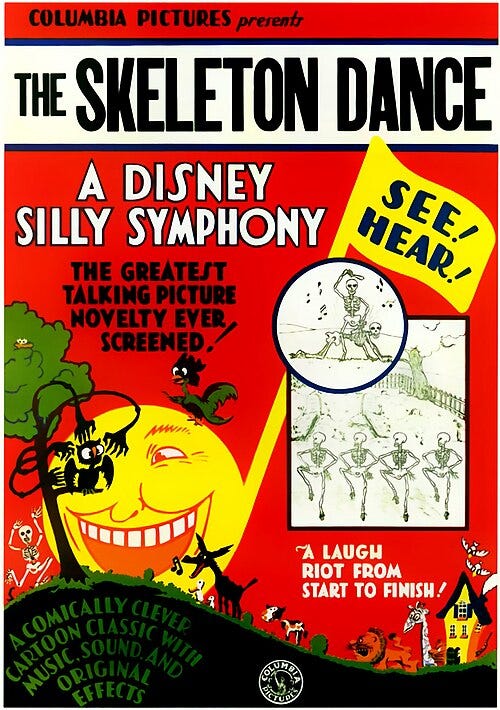
The theatrical release poster for ‘The Skeleton Dance’ boasts that it is ‘a laugh riot from start to finish’ which is…debateable. It also advertised the short’s cutting-edge use of synchronised sound and picture (more on that later on).
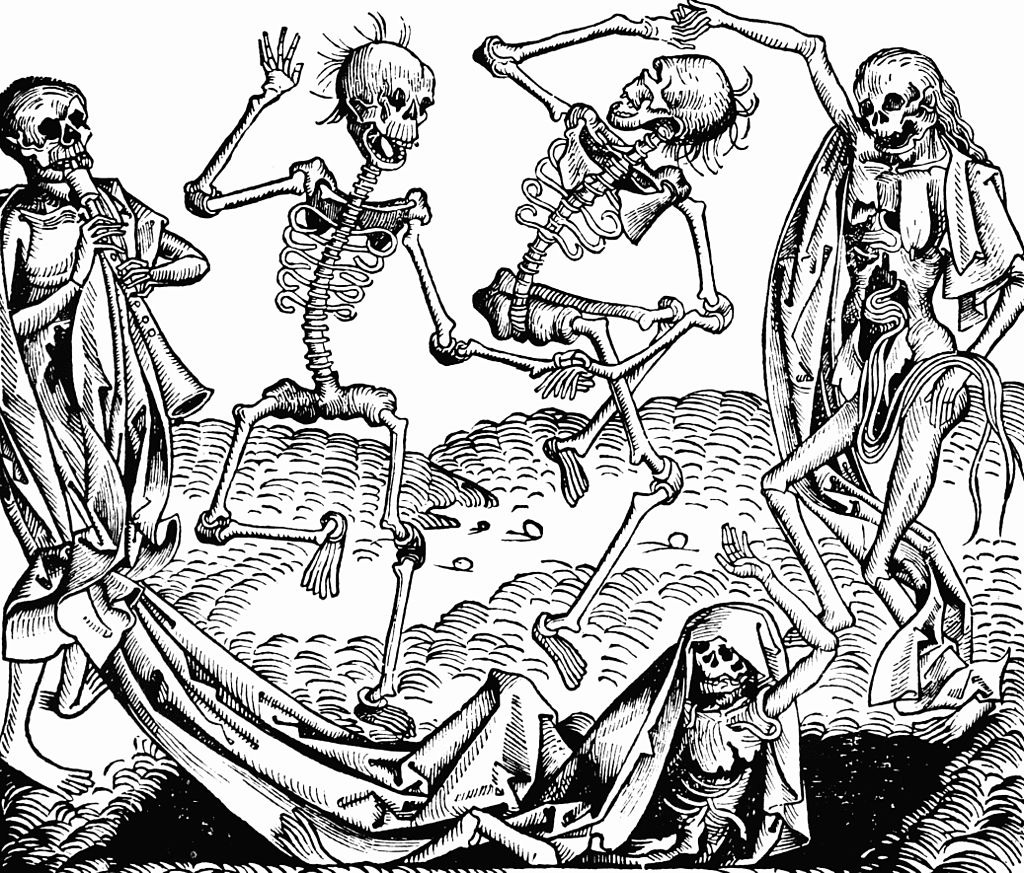
The idea for ‘The Skeleton Dance’ came primarily from the ‘danse macabre’ tradition found across medieval Europe, a popular theme for all manner of decoration from woodcuts and illustrations in books to church decoration (as I explored in my recent article on ‘Doom Paintings’). Here, Death is as playful as he is menacing, popping up with an irresistible tune to mock the pomp and grandeur of the mighty and give a merry exit to the poor and weak.
Thomas Rowlandson’s eighteenth century depictions of cavorting skeletons were another source of inspiration for animator Up Iwerks, a more archly satirical iteration of the old ‘Dance of Death’ motif:1

Music to Make a Skeleton Dance
You might have thought that the creators of ‘The Skeleton Dance’ would have used a piece of music actually composed on the theme of the ‘Dance of Death’, like Saint-Saëns’s popular Danse Macabre. Here, Death appears at midnight on Halloween and there is even a cockerel sound at the end to tell the spooks to return to the tombs – just as there is in the animation.
Danse Macabre is over 7 minutes long and is both melodically and narratively rich, a brilliant example of how storytelling can be done through music. It’s got romantic waltzing sections, bonkers screeching violins, moments when you can almost hear the great torrent of spectres wheeling up and plummeting down in the sky — all of which would have been an absolute nightmare for an experiment in matching animated movement to sound.
The actual music used in the short was a combination of an original score specially created by Carl W. Stalling and a section from Edvard Grieg’s Lyric Suite called Troldtog or ‘March of the Trolls’. The former could be tailored to the little tricks the animators wanted to play with sound, and the latter was far easier to trim and use in brief exciting flurries:
All of this orchestration required a brand new way of matching the frames of the cartoon to the music which became the ‘click track,’ which is still used today.
Carl Stalling and Ub Iwerks both fell out with Walt Disney for periods of their careers. Stalling sent up the name ‘Silly Symphonies’ in his work on ‘Looney Toons’ and Ub Iwerks remade ‘The Skeleton Dance’ in colour as ‘Skeleton Frolic’ in 1937 with original music by Joe DeNat. They reconciled and would work together again, but this was an early sign that tensions behind the scenes would play a significant role in the future of the company.
Lasting Remains
The Skeleton Dance was popular with audiences, although Diane Disney Miller, Walt’s daughter, remembered that:
“Father sat beside the assistant while the film was run. It was just before the first morning show; a few customers had drifted in and it was obvious they liked The Skeleton Dance but the assistant didn't listen to them. 'Can't recommend it,' he said. 'Too gruesome'.”2
Even Variety, which called it a ‘howl’ warned parents “don’t bring your children,”3 and it was banned outright in Denmark for being too macabre.
Just as Iwerks, Stalling, and Walt were using the ‘Silly Symphonies’ to test cutting-edge techniques, 1920s cinema in general was still figuring out how to translate horror for the screen. Questions about how much an audience could take were still tricky to judge, but scaring people has been a staple of the storyteller’s toolkit since time immemorial and the new visual medium was ripe with possibilities for stirring terror. Animation in particular meant that phantasmagoria beyond the bounds of live performance could be brought to grinning, dancing life. Disney and his studio would not forget this.
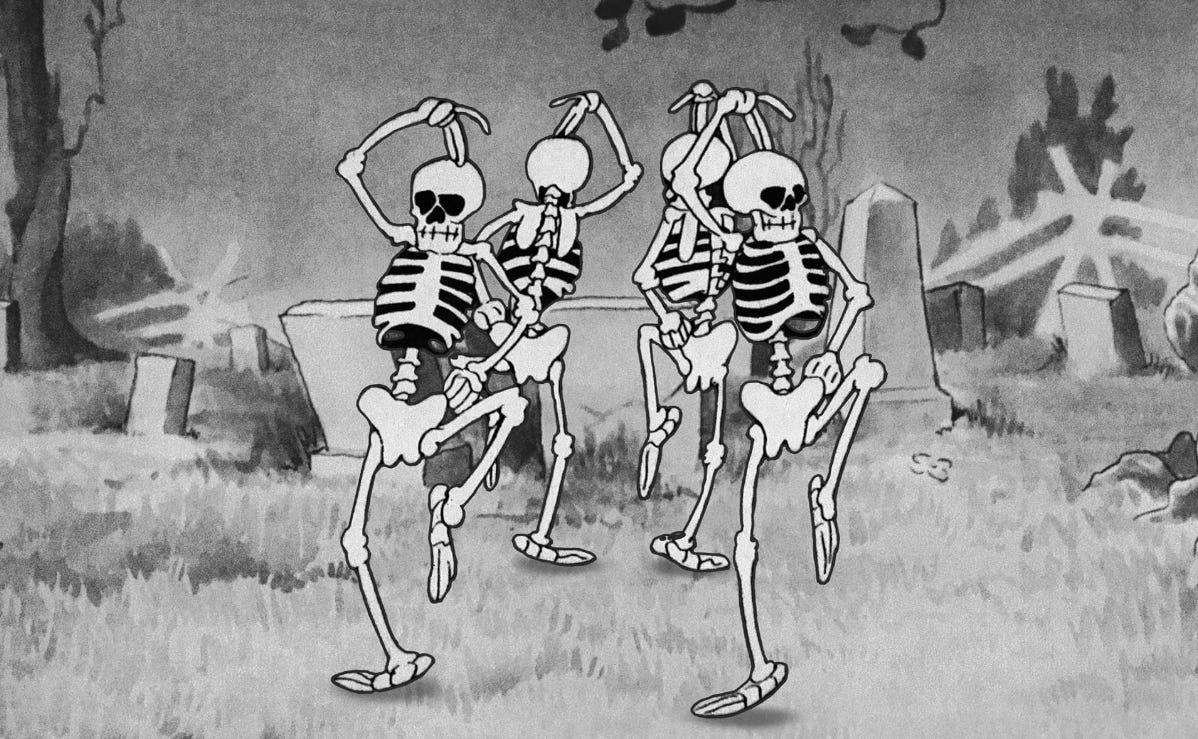
In reinventing the old ‘Dance of Death’ designs, ‘The Skeleton Dance’ provided new enduring visual and musical motifs. In almost any scene where skeletons come to life you can guarantee there will be a reference to this early short, a sinister close-up of chattering teeth, for example, or one skeleton playing another’s ribcage like a xylophone. Just look at ‘The Remains of the Day’ from Tim Burton’s Corpse Bride (2005):
As of today, ‘The Skeleton Dance’ is in the public domain so you and your friends can re-enact it at the Edinburgh Fringe this year without paying The Mouse a cent.
Next week, we meet a poor girl lost in a rather horrifying wood. Until then, happy nightmares everyone!
Horror moments are published on Thursdays and a wide variety of articles exploring the history of magic, theatre, storytelling, and more are published on Mondays.
If you’ve enjoyed Horror Moments and want to help me keep going, please do consider becoming a paid subscriber. You’ll be able to read my archive so you won’t have to worry about losing access to the back catalogue, and every month I publish one thing for paid subscribers only which you can browse here. If you can’t stretch to that, please like, share, comment, subscribe or recommend and thank you so so much for your support!
See https://mouseplanet.com/the-skeleton-dance-story/7655/
The Spooky Story of “The Skeleton Dance” |
Quoted in “Talking Shorts”, Variety, July 17 1929.
I think I have already found my favourite essay of the year, that will be difficult to beat, as it includes so many references I love!
Disney! Fantastic! And can’t wait to read your analysis of “Night on Bald Mountain”, speaking of Fant…Asia😉. Loved this, thank you, Rebekah! I’m guessing Snow White is next!